What Is a Mast Year? Why Seed Crops Boom and Bust
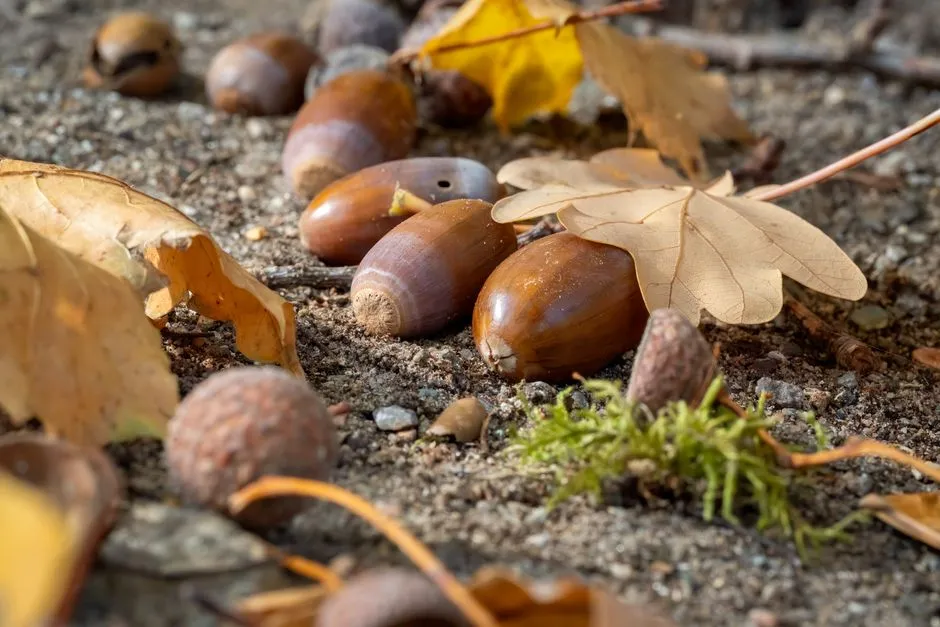
- A mast year is a synchronized seed boom
- Mast production is an output; a mast year is a pattern
- Heavy fruit on one tree is not the whole definition
- Why masting may help plants reproduce
- Weather affects different oak groups on different timelines
- Mast years ripple through wildlife communities
- Poor mast is not automatically poor tree health
- You cannot schedule a mast year by planting one cultivar
- Count mast with a repeatable method
- Manage the habitat, not the boom year
- Sources
A mast year is a synchronized seed boom
A mast year is a season when a population of trees produces an unusually large seed crop, often with many individuals fruiting in synchrony across a landscape. A formally reviewed U.S. Forest Service study defines mast seeding at population scale as seed production that is both highly variable and synchronized. Oaks, beeches, conifers, and other long-lived plants can alternate heavy crops with sparse ones. The interval is not a dependable fixed calendar, and different species—or even neighboring trees—may peak in different years.
A U.S. Forest Service review defines mast as nuts and fruits from woody plants used by wildlife. Hard mast includes nutlike foods such as acorns, hickory nuts, beechnuts, and chestnuts. Soft mast includes fleshy fruits such as cherries, serviceberries, dogwood fruit, and persimmons. A “mast year” often means a conspicuous acorn or beechnut crop in casual conversation, but masting occurs in other plant groups too.
Mast production is an output; a mast year is a pattern
Mast production is the amount of fruit or seed produced by a tree, stand, species, or population during a stated period. Masting describes a pattern across years and plants.
| Observation | What it supports | What it does not prove |
|---|---|---|
| One crown carries many seeds | High production by that tree at that stage | Population synchrony |
| Many same-species trees crop together | Local synchrony in the sampled season | The same pattern across a region |
| A stand shifts from low to high crops across years | Interannual variation at that site | A fixed future schedule |
| A regional index rises | Broad production in its sampled species and area | Equal crops for every tree or species |
Production also changes between flowering, developing fruit, mature crown crop, seed fall, and the ground count left after wildlife removal. A Forest Service comparison of white-oak methods found visual crown surveys useful for comparing production and less affected by wildlife removal than seed traps, while noting observer differences. State the species, area, year, crop stage, and method before calling a number “mast production.”
Heavy fruit on one tree is not the whole definition
Ecologists usually use mast seeding for highly variable seed production that is synchronized among many plants of a species or population. One oak can be a heavy individual producer without the surrounding stand sharing its year.
That distinction matters because individual trees differ. Crown size, light, age, health, genetics, flowering, pollination, and local stress can make one tree productive while another nearby produces little. A 10-year Forest Service oak study found production varied by species, tree, year, and place. One heavily fruiting branch is evidence about that branch; it is not a regional survey.
To describe a local mast event, observe many trees of the same species across the area. Compare with prior years and include trees in different canopy positions. Record crop classes—none, light, moderate, heavy—rather than trying to count every seed.
Why masting may help plants reproduce
No single mechanism explains every masting species, but a major review of mast seeding identifies two ideas with strong support.
Predator satiation occurs when a huge seed pulse exceeds what seed predators can consume. Rodents, birds, deer, insects, and other consumers may take enormous quantities, yet some seeds remain to germinate because the crop temporarily outruns appetites. In low-crop years, consumer populations may have less food, which can help keep the next pulse from being completely eaten.
Pollination efficiency can improve when many individuals flower heavily at once, especially in wind-pollinated species. More pollen moving across the population can increase successful fertilization. Synchronized flowering and synchronized seed production are connected, though development time and weather between flowering and maturity still affect the final crop.
Shared environmental cues and internal resource dynamics also matter. Temperature, frost, rainfall, drought, stored carbohydrates, and prior reproduction can influence flowering and seed development. Their effects differ by species and region.
Weather affects different oak groups on different timelines
A U.S. Forest Service seed-biology guide says North American white-oak-group acorns mature in the year of fertilization, while red-oak-group acorns usually require two years. That developmental difference spreads risk across timelines in a mixed oak stand.
A late frost during flowering can damage one year's white-oak-group crop directly. Red-oak-group acorns developing that autumn originated from flowers the prior year, though current weather can still affect maturation and the tree's new flowers for next year's crop. These layers are why a simple weather event rarely predicts “all oaks.” In one Forest Service study of five southern Appalachian oak species, weather relationships were relatively weak and had limited forecasting value at that site; that scoped result is a warning against universal weather formulas, not proof that weather never matters.
Use the oak, hickory, and beech mast comparison to separate genera and oak groups. The fact that one group failed does not prove another has no food value that year.
Mast years ripple through wildlife communities
A heavy crop creates a resource pulse. Seed-eating birds and mammals may change where they forage, how well they survive winter, or how successfully they reproduce. Those responses can later affect predators, parasites, vegetation, and disease dynamics. A USGS-hosted review of masting consequences describes effects on plant populations, food webs, seed consumers, and zoonotic disease, with responses that depend on scale and time lag; the pathway is not a straight line from acorns to one animal count.
Movement can happen before population growth. Deer, squirrels, wild turkeys, jays, mice, and other consumers can concentrate around abundant mast. Seeing more animals beneath producing trees does not mean the regional population instantly increased; the same animals may have shifted habitat use.
Food is also only one habitat component. Cover, water, nesting sites, den trees, forest age, predators, harvest, weather, disease, and landscape connections matter. A huge acorn crop cannot replace brood cover for turkey poults or a cavity for a squirrel. Wildlife response cannot be reduced to one food input.
Poor mast is not automatically poor tree health
Healthy trees can produce little seed in a normal low year. A sparse crop may reflect flowering conditions, pollination, frost, drought, insects, prior reproduction, or species-level synchrony. Some individual trees are consistently better producers than others.
Evaluate health separately. Look at crown density, leaf size and color, twig growth, bark injury, root-zone disturbance, dieback, pests, and repeated trends. One autumn without nuts is weak diagnostic evidence. Sudden crown decline, extensive dieback, bleeding, unusual leaf symptoms, or structural defects deserve assessment by a qualified forester or arborist.
Likewise, a heavy crop does not prove perfect health. Stress can alter reproduction in some plants, and a tree can fruit while carrying structural or disease problems. Do not retain a hazardous tree beside a house solely for its wildlife food value.
You cannot schedule a mast year by planting one cultivar
Nursery descriptions may advertise early bearing, large fruit, or reliable production. Those traits can be useful when supported, but site, pollination, weather, age, crown development, and regional adaptation remain decisive. A named selection cannot guarantee a heavy crop in a specific calendar year.
For habitat, diversity is the better hedge. Mix locally native species suited to the site, including more than one genus and both hard and soft mast where appropriate. Protect existing mature producers when they are healthy and compatible with the management goal. A newly planted oak may take years or decades to contribute significant mast; the mature tree already doing the job deserves a place in the inventory.
The hard-mast versus soft-mast guide builds a longer seasonal food calendar instead of relying on one acorn event. Diversity cannot eliminate bad crop years, but it reduces the chance that every food source fails for the same reason at the same time.
Count mast with a repeatable method
For a simple landowner record, choose permanent observation points and identified trees. Visit at the same stage each year, ideally before most seeds fall and again after drop. Use binoculars and scan comparable crown sections.
Record:
- Date, tree species, and location.
- Crown position and approximate openness.
- None, light, moderate, or heavy visible crop.
- Evidence of frost, drought, storm, insects, or disease.
- Ground crop and signs of wildlife use.
- Whether nearby trees of the same species match.
Photograph the same crown angle. Do not compare a September observation one year with January leftovers the next. Fallen seeds disappear into leaves, animals, insects, germination, and mower decks at different rates.
Professional mast surveys use more formal visual indices, seed traps, transects, and statistical designs. In one Forest Service rapid-index study, precise regional estimates required 139–385 sampled trees depending on oak subgroup and spatial scale. That study-specific range shows why a small fixed set is a useful property record, not a regional index. Ask whether a forestry or wildlife agency publishes regional reports.
Manage the habitat, not the boom year
Do not radically thin, fertilize, burn, or plant based on one heavy or poor crop. Forest treatments can affect light, crowns, regeneration, invasive plants, erosion, fire behavior, and wildlife structure. A qualified forester should connect any treatment to the stand condition and long-term objectives.
Where planting is appropriate, follow the mast-tree establishment guide: site inventory, native species matching, root-flare placement, wide mulch, water, browse protection, and several seasons of monitoring. Buying more seedlings is easier than keeping the first group alive.
Mast years are pulses, not promises. Observe enough trees to see the population pattern, keep species separate, expect regional variation, and read wildlife response as part of a larger habitat system. Base management on repeated observations, site conditions, and long-term habitat objectives.
Sources
- U.S. Forest Service: Hard and Soft Mast
- U.S. Forest Service: Cross-Species Mast Synchrony
- U.S. Forest Service: Estimating Mast Production
- U.S. Forest Service: Individual Oak Variation
- U.S. Forest Service: Weather and Mast Forecasting
- U.S. Forest Service: Rapid Mast Index
- Annual Review: Mast Seeding in Perennial Plants
- USGS: Ecology and Forecasting of Mast Seeding
- U.S. Forest Service: Seed Biology of Quercus